Tuesday, October 30, 2012

Post #2 Preliminary Research

Last Tuesday's visit to Leavey as a class absolutely helped me find more research on my topic, issues of accuracy in eyewitness identification. I found several psychological studies and reviews of the issue in legal journals. Several of the studies I've found so far focus on issues of memory in identification, while others focus on the impact of these faulty identifications on jurors and convictions.

One article that I found titled, "Fallible Eyewitness Memory and Identification" by Kathy Pezdek discusses eyewitness testimony regarding their identification of the perpetrator as more inaccurate rather than accurate. Pezdek focuses on memory and how the way in which we process memory is inherently error-prone, especially in high stress situations. Pezdek argues for the use of scientific research within this phenomenon, stressing the fact that errors in eyewitness identification must move beyond the use of common sense.

Several of the articles and studies that I have found so far ultimately advocate for a particular solution. More often than not, those solutions were either the use of expert testimony or more intricate judicial instructions.

In furthering my research for the final paper, I hope to find more information on how to make eyewitness identification more reliable. This may include research on how to make police line-ups more reliable, and how the psychology behind the presentation of these individuals may perpetuate the errors in eyewitness identification.


Thursday, October 18, 2012

Post #1 Assignment 4 Topic: Issues of Accuracy in Eyewitness Identification

One of the most famous cases involving error in eyewitness identification can be found in the Brenton Butler case. Back in 2010 Butler, a teenager at the time, was on trial for the murder of Mary Ann Stevens at a nearby motel in Jacksonville, Florida. The police had coerced him into signing a confession and the victim's husband identified Butler as the murderer. Despite the evidence, Butler was acquitted, and the trial is now used as a teaching tool in the errors of eyewitness identification and coerced confessions.

For my research paper, I will explore the issue of accuracy in eyewitness identification. In order to conduct an analysis of eyewitness identification,  I will draw from the fields of psychology and the law.

Eyewitness identification has become one of the most widely studied topics in the areas of psychology and law; primarily because this is an issue that occurs within the legal system and psychology undoubtedly offers explanations for this phenomenon. More often than not the goal of truth discovery is unintentionally neglected in an effort by police officers and investigators to solve the crime. This is an important issue as mistakes in eyewitness identification on behalf of victims of crimes can be detrimental, as well as lead to the production of false positives within the law (those predicted to have committed the crime are in fact innocent).

Inaccuracy in eyewitness identification leads to wrongful convictions, the potential for police to then neglect other leads and instead focus solely on finding evidence that will further implicate their chosen suspect.

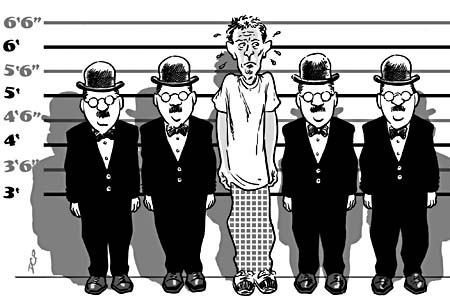
Mistaken eyewitness identification can occur the moment the crime is committed or during the investigation of the crime, through a police lineup. Ultimately, the eyewitness wants to help the police solve the crime, and as a result they feel implicit pressure to identify someone from those presented to them.

A jury will not only assume that any eyewitness identification is accurate, but they will also assume that the victim is confident about their initial description or identification of the perpetrator.

In order to effectively conduct an analysis of this issue, I will need to find research that will provide an analysis of different psychological approaches to understanding errors in eyewitness identification, as well as different statistics that highlight the accuracy in identification and error rate between different races and genders. In general, more background information concerning eyewitness identification and its impact within the legal system will be helpful in constructing an evaluation of the issue.


Tuesday, October 2, 2012

Documentary: Fat, Sick, & Nearly Dead

Obesity in America is more prevalent than ever, and it's certainly a hot-button issue. While I'm certainly not a health expert or an expert in nutrition, I chose this documentary because I found Joe Cross's story to be both interesting and inspiring. Joe Cross embarks on a 60 day journey to better health and he does so through juicing. Why Juicing? Well for starters, as a fast food junkie Joe wasn't receiving any of the essential vitamins and nutrients that are found in fruits and vegetables. In fact, he was malnourished and suffering from a chronic autoimmune disease called urticaria. Joe is clearly obese and in poor health, all at the young age of 41. With the goal of getting off medication completely, Joe began juicing, and as a native to Australia he decided to take his juicing tour to America.

The first 30 days of his journey takes place in New York, and he spends the second half of his juicing challenge traveling across America. I found the documentary and his story to be both inspiring and extremely relevant. Through his juicer, Joe sets out to show the American public that there can be a different type of fast food, a fast food packed with micro-nutrients that are essential for one's health.

The documentary also incorporate two other real-world examples. Siong, a chronic migraine sufferer, embarks on a 10-day juice fast in hopes of improving her health. Joe, a truck driver, is also suffering from urticaria, and he embarks on a 60 day juice fast just like Joe did. Both examples are clearly used to show the audience that we can all play an active role in the improvement of our health.


Click here for the link to the film


Below is the trailer for the film: